
About the M3 Motorway
The M3 is one of southern England's most important motorways, carrying traffic between the south-western edge of Greater London and the south coast. For drivers heading to Hampshire, Southampton, the New Forest, and the ferry ports for the Isle of Wight, the M3 is a vital artery, and for hundreds of thousands of commuters, it's part of daily life.
The basics
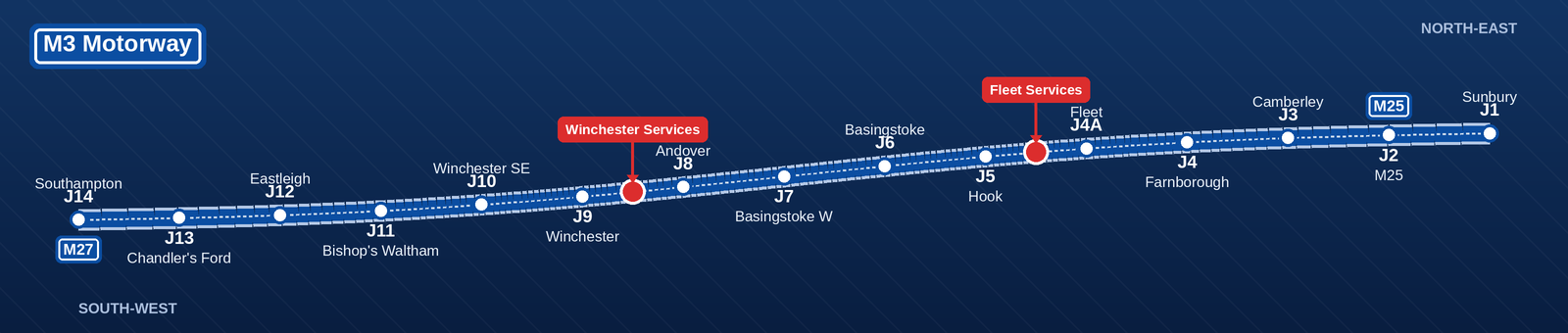
The M3 runs for approximately 59 miles (95 km), from Sunbury-on-Thames in Surrey, on the edge of South West London, down to the Southampton area in Hampshire. It begins as a continuation of the A316 from London and was originally conceived as the "London to Basingstoke Motorway."
For most of its length the M3 is a wide, dual three-lane motorway, but it has one notable narrowing: between Junction 8 (for the A303) and Junction 9 near Winchester, it reduces to dual two lanes as it passes through quieter, rural Hampshire countryside, before widening again on its approach to Winchester and the south.
A motorway that took over 20 years to build
The M3 wasn't built all at once. The first sections opened in 1971, but the entire motorway wasn't completed until 1995, meaning it took over 20 years to finish the whole road. The core section from Sunbury to Popham opened first in the early 1970s, with the motorway then extended southward in stages. It was built to relieve the congested A30 and A33 single-carriageway trunk roads that previously carried all the traffic to the south coast.
One later addition was Junction 4A, which opened in April 1992 to serve Fleet.
Twyford Down: the M3's most controversial chapter
The final stretch of the M3, the section south-east of Winchester, became one of the most famous road-building controversies in British history. The route had to get past St Catherine's Hill, an ancient and important hill fort. The solution, which opened in 1995, was to carve an exceptionally deep cutting through high ground at Twyford Down, leaving the ancient monument intact but cutting through a scenic and scientifically valued landscape. The plan attracted opposition from environmental campaigners across Britain, and numerous road protests were held that delayed the motorway's opening. Twyford Down is often regarded as the beginning of the backlash against road-building in the UK, a turning point that saw new road schemes fall out of political favour for many years afterwards.
How busy is it?
The M3 is not an especially long motorway, but it is far from quiet. Over the years its busiest section, at Chandler's Ford near Southampton, had carried daily average of around 130,000 vehicles or more. To help manage heavy traffic near London, the section between Junction 2 and Junction 4A was converted into a smart motorway, fully opened on 30 June 2017, using variable speed limits to keep traffic flowing.
The towns and places the M3 connects
Travelling from London to the coast, the M3 serves a string of well-known Hampshire and Surrey towns. The route includes the Aldershot urban area, Basingstoke, Winchester, and Southampton. Along the way its junctions serve Sunbury-on-Thames, Camberley, Farnborough, Fleet, Hook, Basingstoke, Andover (via the A303), Winchester, Eastleigh, and Chandler's Ford.
Key connections
The M3 links directly to two other major motorways: it meets the M25 London orbital motorway at Junction 2, and at its southern end it connects to the M27, which distributes traffic along the south coast towards Portsmouth and around Southampton. The southern section from Junction 12 to Junction 14 (for the M27) was created by upgrading part of the old A33 road to motorway standard, opening in 1991.
A quirky piece of history: the "Spitfire Bridge"
Near Winchester, the M3 passes beneath a crossing known as the Spitfire Bridge. The name comes from October 1941, when a pilot, George Rogers, flew a Curtiss P-40 aircraft under the original bridge that stood there, and it was locally assumed to have been a Spitfire, giving the bridge its enduring nickname.